
Play Le Santa Now!
Home → Strategy
Le Santa Strategy
Approaching Le Santa sensibly
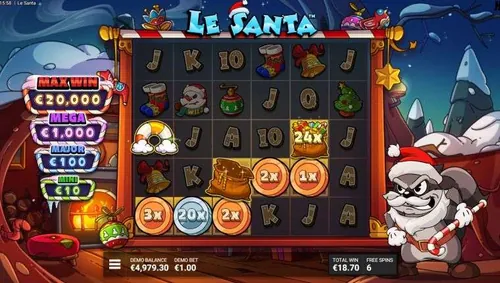
Le Santa is an online slot released in 2025 by Hacksaw Gaming, featuring a 6x5 grid with Cluster Pays mechanics and a theoretical RTP of 96.14% against a house edge of 3.86%. This configuration allows for a maximum win of 20000x, though other versions exist at 94.18%, 92.25%, or 88.25%. Players must verify the active RTP before playing, as lower configurations significantly reduce long-term returns.
The game utilizes a medium volatility profile, meaning wins occur with moderate frequency rather than rare large payouts or constant small ones. This balances the potential for hitting the 20000x cap with manageable bankroll depletion during dry spells. Understanding this distribution helps players set realistic expectations for session duration and win rates.
Unlike crash games, Le Santa has no cash-out button, requiring players to accept the random outcome of each spin without intervention. The bet range spans from 0.10 to 50, offering flexibility for different budget levels while maintaining the same underlying mathematical structure across all stakes.
Bankroll rules that hold up
A disciplined approach to bankroll management requires setting aside a specific amount of money, known as the bankroll, before opening Le Santa. This sum should cover at least 100 spins at the minimum stake of 0.10, ensuring sufficient playtime to experience the medium volatility without immediate ruin. Flat betting keeps the stake constant, preventing rapid depletion during losing streaks.
Progressive staking strategies involve raising stakes after losses, which does not change the built-in edge and only shortens the time to ruin. Since Le Santa offers configurable low-RTP versions like 88.25%, relying on such systems increases the risk of exhausting funds faster than statistical averages predict. Maintaining a fixed stake preserves capital longer across varying RTP configurations.
Comparing Le Santa to other titles reveals consistent design principles among Hacksaw Gaming releases. For instance, Le King shares the same 96.14% RTP and 20000x max win, while Le Zeus matches these figures exactly. Such comparisons help players identify similar volatility profiles and payout potentials across the studio's portfolio.
Bet sizing against volatility
The medium volatility of Le Santa suggests that bet sizes should align with the player's total bankroll to withstand variance. A common rule is risking no more than 1% of the bankroll per spin, meaning a 100 bankroll supports a 1.00 stake. This ratio ensures survival through typical losing sequences inherent in cluster pay mechanics.
Adjusting bets based on recent outcomes often leads to emotional decision-making rather than mathematical optimization. Since the RTP remains fixed at 96.14% regardless of previous results, increasing wagers after wins does not improve expected value. Instead, sticking to a predetermined percentage of the bankroll maintains consistency and reduces impulsive errors.
Other Hacksaw titles like Wanted Dead or a Wild feature high volatility, requiring larger bankrolls relative to stake size due to infrequent but larger wins. In contrast, Le Santa's medium volatility allows for smaller relative stakes while still targeting the same 20000x maximum win potential, offering a balanced risk-reward profile for cautious players.
Common systems and their limits
The Le Santa slot by Hacksaw Gaming features a 6x5 grid with Cluster Pays mechanics, which eliminates traditional paylines in favor of adjacent symbol groups. This structural design means wins depend on spatial connectivity rather than linear alignments, fundamentally altering how players track outcomes across the reel layout. Consequently, bettors must adjust their expectations regarding hit frequency compared to classic three-reel formats.
Hacksaw Gaming sets the theoretical RTP at 96.14% for this title, establishing a house edge of 3.86% over extended play sessions. This percentage represents a long-run average across hundreds of thousands of spins, ensuring that short-term variance does not reflect the actual mathematical expectation. Players should recognize that individual sessions will deviate significantly from this central tendency due to random number generation.
The maximum win cap is fixed at 20000x the total stake, providing a clear upper limit on potential payouts regardless of bet size or feature triggers. This ceiling applies universally across all configurations, meaning even high rollers cannot exceed this absolute payout threshold during any single bonus round or base game spin. Understanding this hard limit helps manage bankroll expectations realistically.
Flat betting explained
Le Santa allows wagers ranging from 0.10 to 50 per spin, enabling players to select a consistent stake amount for every round played throughout the session. This approach avoids the emotional volatility associated with changing bet sizes after wins or losses, maintaining a steady risk profile relative to the available bankroll. Such consistency simplifies tracking total expenditure and potential returns over time.
The medium volatility setting indicates that Le Santa offers a balanced distribution of win sizes, neither extremely frequent small payouts nor rare massive jackpots. This characteristic aligns well with flat betting strategies, as it reduces the likelihood of rapid bankroll depletion while still offering opportunities for significant gains. The 6x5 grid structure supports this balance by allowing multiple cluster formations per spin.
Choosing a fixed stake within the 0.10 to 50 range ensures that each spin carries identical risk exposure, preventing accidental overspending during winning streaks or frustration during dry spells. This methodical approach complements the 96.14% RTP by preserving capital longer, allowing more spins to occur before the house edge fully materializes in the final account balance. Discipline remains key to sustaining play under these conditions.
Le Santa: key facts
| Parameter | Value |
|---|---|
| Game | Le Santa |
| Studio | Hacksaw Gaming |
| Released | 2025 |
| RTP | 96.14% |
| House edge | 3.86% |
| Volatility | medium |
| Max win | 20000x |
| Reels | 6x5 grid |
| Paylines / ways | Cluster Pays |
| Bet range | 0.10 – 50 |
Progressive staking risks
Progressive staking involves increasing the wager after each loss, a strategy that fails to alter the built-in 3.86% house edge inherent in the Le Santa slot mechanics. While raising stakes might seem logical to recover previous deficits, the mathematical expectation remains negative regardless of bet size adjustments made during the session. This fundamental truth holds true for all configurable RTP versions offered by the provider.
Hacksaw Gaming provides alternative RTP configurations such as 94.18%, 92.25%, and 88.25%, which further exacerbate the risks associated with progressive betting systems. Lower RTP values increase the house advantage, accelerating bankroll erosion when combined with escalating bets following losing clusters. Players using these settings face compounded disadvantages without any corresponding increase in expected value.
The 20000x max win cap restricts the upside potential needed to justify aggressive progression models, making recovery of accumulated losses increasingly difficult over time. Since the payout limit is fixed, no amount of increased wagering can generate returns exceeding this threshold, rendering high-risk staking methods mathematically unsound. Responsible play requires accepting the limitations imposed by both volatility and maximum win constraints.
What the maths actually allows
The 96.14% RTP figure for Le Santa implies that for every 100 units wagered, approximately 96.14 units are returned to players theoretically over infinite time. This calculation establishes a baseline expectation but does not guarantee specific outcomes in shorter playing periods due to the inherent randomness of slot machine algorithms. Real-world results will fluctuate widely around this mean value.
Medium volatility suggests that Le Santa produces moderate-sized wins with reasonable regularity, balancing the need for sustained engagement with occasional larger payouts. This characteristic influences the optimal bet sizing strategy, as higher volatility games require larger bankrolls to withstand longer losing streaks before hitting significant clusters. The 6x5 grid facilitates this dynamic by offering diverse winning combinations.
With a maximum win of 20000x, the highest possible return from a single spin depends directly on the stake placed, capping absolute gains regardless of RTP configuration. For instance, a 50 unit bet could yield up to 1,000,000 units if the maximum multiplier is achieved, though such events remain statistically rare. This cap defines the upper boundary of potential profitability within the game's framework.
Reading variance honestly
Variance in Le Santa reflects the degree of deviation from the average return, driven by the medium volatility setting and the Cluster Pays mechanic on the 6x5 grid. High variance periods may result in extended sequences without wins, testing player patience and bankroll management skills despite the favorable 96.14% RTP. Recognizing these fluctuations prevents misguided decisions based on short-term performance.
The configurable RTP options including 94.18%, 92.25%, and 88.25% introduce additional layers of complexity, as lower settings significantly increase short-term unpredictability for players. Choosing a higher RTP version mitigates some variance impact by reducing the house edge, thereby improving the likelihood of maintaining a stable bankroll over time. Awareness of these variations is crucial for strategic planning.
A max win of 20000x serves as a critical reference point for understanding potential upside, reminding players that extreme outcomes are bounded by this fixed limit. This constraint means that even during highly volatile stretches, losses cannot be offset by unlimited winnings, reinforcing the importance of disciplined betting practices. Honest assessment of these parameters aids in realistic expectation setting.
Learning the game in demo first
Hacksaw Gaming released Le Santa in 2025, establishing a medium volatility profile that balances risk and reward for new players exploring the mechanics. This specific volatility setting ensures that wins occur with moderate frequency, preventing long dry spells while maintaining potential for significant payouts during bonus rounds. Players can observe these dynamics without financial commitment by utilizing the free demo mode available on review sites. The demo allows users to test the cluster pays mechanic safely before deciding whether the game fits their personal preferences.
The game operates on a 6x5 grid using Cluster Pays instead of traditional paylines, requiring adjacent symbol groups to form winning combinations across the reels. This layout structure influences how often symbols connect, directly impacting the perceived hit frequency during initial play sessions compared to linear slot formats. Understanding this spatial requirement helps players adjust their expectations regarding win patterns and timing throughout extended gameplay periods. The absence of fixed lines means every spin offers multiple potential pathways for creating qualifying clusters on the board.
Le Santa features a theoretical return to player rate of 96.14%, which represents the average percentage of wagered money returned over millions of spins. This RTP figure serves as a long-term statistical benchmark rather than a guarantee for individual gaming sessions or short-term play outcomes. Variations such as 94.18% or 88.25% may appear depending on the operator's configuration settings chosen for different jurisdictions. Recognizing these configurable options helps players understand why payout percentages might differ slightly between various casino platforms offering the same title.
Adjusting stakes to your budget
Betting limits range from 0.10 to 50 per spin, providing flexibility for both casual players with smaller bankrolls and high rollers seeking larger wagers. This wide spectrum allows individuals to select stakes that align precisely with their available funds while minimizing the risk of rapid depletion during play. Lower bets extend session duration by reducing the cost per spin, enabling more opportunities to trigger bonus features like free spins or multipliers. Conversely, higher stakes increase potential returns but accelerate the consumption of the total bankroll allocated for gaming activities.
A maximum win cap of 20000x applies to all successful rounds, defining the upper limit of potential payouts regardless of the stake size selected by the player. This multiplier constraint ensures that even with substantial wagers, winnings remain within predefined boundaries set by the game developer Hacksaw Gaming. For example, betting 50 per spin could theoretically yield up to 1,000,000 if the maximum multiplier is achieved through complex cluster formations. Understanding this ceiling helps manage expectations and prevents unrealistic assumptions about infinite winning possibilities during any single gaming session.
House edge calculations derived from the 96.14% RTP indicate a theoretical retention rate of 3.86% by the casino over extended periods of continuous play. This percentage reflects the mathematical advantage built into the game mechanics, influencing long-term profitability for operators rather than individual player success rates. Players should consider this edge when planning their budget, ensuring they allocate sufficient funds to withstand inevitable losing streaks inherent in random number generation. Adjusting stake sizes proportionally to one's total bankroll remains the most effective strategy for mitigating the impact of this built-in disadvantage.
Recognising a bad session
Medium volatility in Le Santa suggests that losing streaks may persist longer than in low volatility games, potentially draining a bankroll faster than anticipated during unfavorable runs. Players monitoring their balance should watch for consecutive non-winning spins exceeding typical statistical averages, which might indicate an unusually tough sequence of random outcomes. Tracking the number of spins versus losses helps identify when variance is working against them rather than reflecting poor decision-making or strategic errors. Recognizing these patterns early allows for timely adjustments or pauses before emotional responses lead to reckless betting behavior or chasing losses.
Flat betting strategies involve maintaining the same stake amount throughout each round, avoiding progressive staking methods that raise bets after losses to recover funds quickly. Progressive approaches do not alter the underlying house edge and typically shorten the time until complete ruin by accelerating capital consumption during downturns. By sticking to consistent wagers within the 0.10 to 50 range, players preserve their bankroll integrity and extend overall playing time effectively. This disciplined approach reduces exposure to extreme variance swings that often characterize high-stakes gambling environments where emotions run high.
The presence of configurable RTP versions ranging down to 88.25% means some operators may offer Le Santa with significantly reduced return percentages compared to the standard 96.14%. Identifying which version is active requires checking game information panels or contacting support, as lower RTP configurations inherently increase the house advantage substantially. Playing on reduced-return versions accelerates bankroll erosion even with identical bet sizes and volatility profiles observed in higher-RTP iterations. Awareness of these variations enables informed decisions about which platform offers the most favorable mathematical conditions for sustained engagement.
Stopping while ahead
Reaching the maximum win threshold of 20000x represents a rare but highly lucrative outcome that signals optimal timing for concluding a gaming session immediately. Securing profits at this peak prevents subsequent spins from reversing gains due to the inevitable regression toward the mean dictated by the house edge. Players who cash out after achieving substantial multipliers protect their earnings from being recaptured by the random nature of cluster pays mechanics. Setting predefined profit targets based on initial bankroll multiples provides a clear exit strategy independent of emotional impulses or greed-driven continuation.
Bankroll management principles dictate allocating only a fraction of total funds to any single session, ensuring that even significant losses remain manageable within broader financial plans. If a player deposits 100 and achieves a 500 win, withdrawing 400 leaves 100 to continue playing risk-free with remaining house money. This method isolates losses to predetermined amounts while preserving core savings intact, promoting responsible gambling habits aligned with sustainable entertainment goals. Stopping upon hitting preset withdrawal thresholds reinforces discipline and prevents the common pitfall of reinvesting all winnings into further speculative plays.
Time-based limits complement monetary stops by enforcing regular breaks that interrupt prolonged exposure to repetitive slot mechanics and potential fatigue-induced errors. Taking hourly pauses allows players to reassess their mental state and objective performance metrics before committing additional resources to continued play. Monitoring elapsed time alongside financial results creates a balanced framework for evaluating whether current engagement remains enjoyable or has become compulsive. Implementing automated timers or self-exclusion tools enhances adherence to these boundaries, safeguarding against impulsive decisions made under stress or excitement.
Responsible play in practice
Utilizing deposit limits imposed by operators restricts daily or weekly spending caps, preventing excessive expenditure beyond pre-approved financial thresholds established by the player. These controls act as safeguards against impulsive behaviors driven by temporary emotions or perceived winning streaks that rarely persist in probabilistic systems. By setting hard boundaries on available funds, individuals maintain greater control over their relationship with gambling activities and reduce risks associated with problem gaming patterns. Regularly reviewing and adjusting these limits ensures they remain aligned with current financial circumstances and personal comfort levels regarding risk tolerance.
Self-assessment tools provided by reputable casinos help players evaluate their motivations and behavioral patterns objectively, identifying early warning signs of potential addiction or unhealthy habits. Completing periodic questionnaires encourages reflection on reasons for playing, frequency of visits, and emotional responses to wins or losses encountered during sessions. Honest self-evaluation fosters awareness of personal vulnerabilities and promotes proactive steps toward maintaining healthy attitudes toward entertainment and leisure activities. Seeking professional guidance when needed demonstrates strength rather than weakness, supporting long-term well-being amidst recreational pursuits involving chance elements.
DemoRTP & VolatilitySymbols & PayoutsBonus FeaturesStrategyBonusesMobileDownload & AppMax WinSimilar GamesReviewFAQSitemap
Le Santa 2026